Oct 12, 2009

Behind the Scenes | Trail Running in Kauai Hawaii


5 Reasons to take your next commercial photography assignment to Kauai, Hawaii (as if you really needed one!)


1- The best climate in the world to shoot in. You can actually get by with just the clothes on your back (or board shorts) when your airline (United in this case) loses your luggage for two and a half days!
2- An Island that's small enough to find super remote, virtually private locations, but large enough to host a Costco (hotdogs to feed the crew are essential).
3- Shooting in board shorts and flip flops (errr..."slippah's" as I was routinely corrected by the locals).
4- Locations, Locations, Locations: 1) Na Pali Coast 2) Waimea Canyon 3) Hanalei Bay 4) Pretty much anywhere you set foot after stepping off of the plane.
5- Aloha spirit! People were sooo cool! Models, Condo rental, etc. Everyone except the FedEx shipping people in Princeville who wanted to charge me like $15 per package to 'process' an FedEx order.


Okay, so we had a four days worth of commercial work to get done as well as a few on-going personal projects to continue while in Kauai, so I must admit I was pretty much in panic mode when my bags didn't arrive for over two days after landing. Fortunately, I always carry my camera, back-up camera and lenses on the plane with me. Lighting and other equipment was checked, but worst case scenario, I can find a rental house in most locations if the airline loses my checked gear. Monday around noon, I finally got the call I was praying for and the 3rd party courier was on his way to deliver my baggage...thanks you! (btw- do you tip this guy??)


Daniel (local trail runner and pretty much the nicest guy I've ever met), showed us around the island including helping find great trail running locations for our shoot. The day of shooting with him, he probably put in at least 10 solid miles of running up and down the Na Pali coast trail, the Power Line trail and a few others in order to capture multiple locations and a ton of unique angles, lighting styles, and looks.


Included in the bunch, was this shot and this shot. We were fortunate enough to have some really nice rolling clouds come over the mountains in the background, creating a nice sense of drama as well as a beautiful diffused light (backlight). As you can see in the video, we drove as far as we could in our rental Ford Explorer and then took the gear up a little bit further on the trail to a section that opened up over-looking Hanalei bay and the whole North Shore coast line. It was absolutely gorgeous. I decided to shoot just wide enough to capture the stunning location, but tight enough to be drawn into the runner his experience.


We used a combination of tools for the shoot all of which were essential in making the shots featured:


1) Location
2) Awesome Talent: Daniel
3) Main Camera: Canon 5D Mark II and 16-35 II lens
4) Lighting Equipment: Elinchrom Ranger RX Speed AS Battery Pack with A - Lite Head
5) Lighting Modifiers: Clouds, 27x27 Rotalux soft box minus the diffusion panel (Key)


Oct 8, 2009

New Canon 7D has arrived at my front door.

I'm not one to jump up and down about the newest, coolest, latest gear...but...why not once in a while...


Things I love about the new Canon 7D

1- Feels great in hand. New design feels much more natural in my hand than 50d, 40d, or even 5D Mark II
2- Wireless flash control. From the on-board pop-up flash, you can now control (wirelessly) speedlights. A first for Canon, but it's about time.
3- Ful 1080p HD video with dedicated switch - 60FPS in 720HD mode. 24p option in 1080 HD. Awesome!
4- Potential weather proofing resistance resistance (my major complaint with the 5D Mark II!)
5- Auto Focus Rocks! AI servo is on the money for horizontal and vertical shots
6- 8FPS
7- Price $1699. less than 2 years ago these features were $4-5,000 on a 1D body
8- High ISO looks pretty clean so far for stuffing 18megapixels into a cropped sensor
9- Same battery as 5D Mark II

Wish List:

1- FULL FRAME
a) Non-crop body or option for crop or no crop version. Although will be nice for some sports and wildlife, turning a 400mm lens effectively into a 640mm lens @ 18mp
b) Please bring these exact same features to a FULL FRAME version (5D Mark III or 3D).

2- Better WIRELESS control
a) Longer range than 10-12 feet
b) Wireless flash control with a 580 EX II sitting in the hotshoe. Okay, so let's say I want to control three speedlights (580 EX II's) for something similar to a shot like this bow hunting image. I two lights on each side of the subject and a little bit of fill flash on or near the camera. Right now, you can use the pop-up flash on the 7D to control external speedlights, but if I mount another 580EX II in the hotshoe, I lose control of adjusting the settings from the camera. You can still make all three flashes fire, but have no control of the power settings on the external flashes. This would be beautiful for jobs without multiple assistants.

How will I use the camera?

1) Sports photography, Wildlife Photography when long distance, fps, and AF tracking are important.
2) Moon photography. Throwing a 400 or 600mm lens with 1.4 and 2x Teleconverters will make for some really nice Moon images especially with the LiveView 10x focusing and 18MP to work with for cropping.
3) Slow Motion, 60FPS video. The 7D will function as a primary back-up camera for my commercial photography work and also another source of video shooting for both behind the scenes shoots as well as utilizing the 60FPS when I need to slow down the video - sports photography and video related work comes to mind first.

I'm extremely excited about this camera, especially at this price point. Canon's put out a pretty sweet set of features in this body. I may have more on the wish list once I've had the camera for more than a day. Will update soon.

Some more links:
Difference between true 60FPS on 7D and slowing down 5D Mark II to imitate 60fps

Oct 5, 2009

Magazines are changing! Video integrated in Outside Magazine article

This little clip from Alexx Henry featuring the motion shoot for an Outside magazine article and cover is pretty fascinating. What will the magazine racks of the future look like?


move still and video at http://www.kevinwinzeler.com

Oct 2, 2009

Photographing the tallest tree in the world: National Geographic

This is a pretty short (1:27) and cool clip on how the latest photographs of one of the tallest Redwoods alive were created for the most recent issue of National Geographic magazine. I love thought provoking photographs that require a great deal of pre-visualization, planning and execution. Looks like three 1Ds Mark III cameras angled in three different directions, 6 pocket wizards, and a ton of rigging (3 weeks worth). Sweet!


More landscape images can be found at http://www.kevinwinzeler.com

Oct 1, 2009

Ski season's approaching: Powder Magazine Ad (Salomon)

The October issue of Powder magazine is featuring a Salomon ad with several of my images and some awesome skiing from Jared Allen. Check it out!


See more skiing photography in Utah and other areas of the world here: http://www.kevinwinzeler.com
Ad design also done by Jared Allen here:

Sep 25, 2009

Dirt Jumping From I-Street


Having just returned from Interbike in Vegas I thought it would be fitting to post a few shots from a recent shoot we did on some dirt jumps above the Capital building here in Salt Lake City, Utah known as I-street. We caught sunrise coming up over the Salt Lake Valley and shot both action and lifestyle with my good buddy and dirt jumper Craig Saunders. I haven't been on the dirt nearly enough this Summer, but it was excellent to get out for a little riding and shooting. Also, check out some prior published dirt rag mag shots on both the bobsled trail and i-street.The week prior I was down in Brianhead Utah shooting some of the most epic trails in Utah and definitely one of my favorite spots to ride. I'll be posting some of those images soon.

Sep 22, 2009

Decisions...decisions...decisions...

The priority list

What should you do next?

Is it better to email an existing customer, send a brochure to a prospect or improve your product a bit? Should you tweet or post a new blog post? Should you have a meeting to coordinate your team or spend ten minutes returning phone calls instead?

This is an unheralded skill, something successful people do really well and others struggle with.

How do you decide what to do next?

check out the rest of the post here:

Seth Godin's blog has daily posts that are pretty relevant to running any business including acommercial photography business.

Sep 15, 2009

On the road: Hawaii, Kauai


Blogging from the road trip can be difficult, but finally discovered a little Wi-fi connection from my deck so here's a quick post from the beautiful island of Kauai (garden island). First time to this island and I'm it's my favorite at this point. Planning on returning on a non-work trip. During my first two days on the island and in between scouting my commercial locations, I snapped a few landscapes to go along with other hawaii landscapes from years past. Otherwise, I have barely had a chance to breathe with early mornings and late evenings doing commercial shoots. Luckily my bags arrived just in time to get started on the shoots (3 days late though!!!). I'll save those details for another post...

Lone tree on the road to Poipu on the South side of the island of Kauai, Hawaii:

Tunnels Beach on the North Shore of Kauai, Hawaii just after Sunset:


Hanalei Bay on the North Shore of Kauai, Hawaii:


Kilauea Lighthouse on North Shore of Kauai, Hawaii


Aug 28, 2009

Aviation pics that rock!

Just got back from a trip out to the midwest, more on that later. So, I'm catching up on a few of the photo blogs I frequent and came across some "in flight" pictures that are pretty amazing. I love flying and miss the cruising around the local air space in a single engine plane, so these get me excited. It also reminds me to put the local, Hill Air Force Base - air show on my calendar for 2010. We hit it a few years back and caught some fun stuff. One shot from the show of an F22 Raptor: http://www.kevinwinzeler.com/gallery/8453291_gHwjH#562117835_rCqKQ-X2-LB

And now for the big picture shots...


Aug 19, 2009

We have a winner...Triathlon Shoot

Well actually I'm going to call it a tie. While all the contributers had some great insight to offer, SkiMoab and Justin came closest to the actual photo shoot scenario and thus are the winners of an 8x12, signed print of choice from http://kevinwinzeler.com


Here were their entries:

SkiMoab: In Utah Lake, in the morning. You're in the water with two different flashes attached to the boat. The shutter had to be fast to keep it crisp, but there's a slight delay to blur some of the droplets to show motion/speed.
Instructions were to look intense/mad and to hold his head a bit out of the water so you weren't getting just half of his face. Some post-processing to shade the edges.

Justin: Here is my very amateur analysis. Knowing you, you are probably down in the water a few metres from the swimmer. You have a couple of off camera flashes to provide the lighting. The swimmer was instructed to swim towards you and continue on a short distance beyond you so that as swimmer passed by you could capture him/her in fullstride.

(*email me with the print you would like)

SkiMoab and Justin both had the key elements correct -- 3 off-camera flashes Canon 580EX II's (although soon to be replaced with the amazing little Elinchrom Quadra AS battery pack system!) in a sandwich technique (front and behind swimmer). I'm in the water, just a few feet down the boat ramp (Utah Lake - Provo boat dock). I also have a waterproof casing (ewa marine housing) on the camera and wideangle lens Canon 16-35 f/2.8 at the widest 16mm length; all attached to the Canon 5D body (have since upgraded to the Canon 5D Mark II) and triggering remote flashes wirelessly via pocket wizard plus II's close to the Swimmer and instruction to the swimmer to swim just past my taking the pictures. There was also some post-processing work as you'll see in the before and after below to bring a bit more contrast and mood to the image. I didn't provide any instruction to how the Swimmer should look in terms of facial expressions other than to keep true to her normal swimming technique. Oh and the MAX shutter speed for a DSLR when using off-camera flashes is around 1/200th of a second. Unfortunately, that's typically too slow for freezing action completely, especially when you're mixing in ambient light, so a little bit of panning is necessary to keep everything sharp.

Check out the behind the scenes video for the lighting set-up, time of day, and interaction with the talent before and after the shoot.

Aug 6, 2009

WIN an 8x12, Signed Print -- Behind the Scenes Video

STOP!!!

Okay, BEFORE you watch the behind the scenes video, spend at least 3 minutes (180 seconds) studying this image and writing a comment below about how this photograph was made. I don't care what your background is or whether you're a photographer, artist, engineer, teacher, millionaire or of some other background; it doesn't matter, use your imagination here folks (ideas could be centered around: camera settings, lens length, instructions to athlete, lighting, time of day, location, elaborate set-up or not, photographers position, post-processing, studio work, compositing, CGI....etc.). Don't limit yourself and remember you're on your honor to look, study and write a comment before pressing play...! If your ideas come closest what took place on the shoot, an 8x12, signed print is coming your way!- Prints here: http://kevinwinzeler.com (*note- if you were on the shoot, hold the comments :)


The NEXT blog entry will delve into the specifics behind this photo shoot, from diagrams, to lighting ratios, to an analysis of what I liked and also what I would have done differently looking back on this shoot a year later. Stay tuned....


Aug 4, 2009

Creating photography for Design


The finish line is further down the road! I'll speak in broad terms here, but don't we as photographers end a bit too quickly when planning and shooting in terms of what the end uses of our photo will be? We take pictures that in our mind are complete, nicely wrapped, stand-alone items and call it good. So what's missing? Probably nothing for a fine art photographer, but for the commercial photographer, the process has just begun! I just finished an article that really resonated, not because I'm a designer, but rather because I'm a commercial photographer that works with designers, art directors and creative directors on a regular basis, I can hear their little voices in my head, screaming to us as photographers to the pay more attention to Design. Clean Lines. Provoke emotion. Visual cues that solidify the message. Texture. Details. More space for beautiful TYPE! I hear you. (if you're a designer reading this, we are listening. Comment with what is missing for you.

"Of course, smart photographers without a design background may well ask those questions too but it’s also likely that many photographers are more concerned about the technicalities of creating the image than producing a product that a designer will have to use. They want to create good photos. And even those photographers who do understand that a good commercial image isn’t just one that’s well-focused and finely-composed but also usable, might not consider whether there will be room for text or a headline if the image is run full bleed on a layout, or how the background elements may enhance or obstruct type and graphic elements laid over the photo...."


Image below: "Abandoned Lift" from the archives of Kevin Winzeler:


Aug 2, 2009

Golf Photography

I love golf! Pure and Simple. So combine stunning photographs with a super cool sport and I'm in.


Golf - Images by Darren Carroll

This is a funny and informative post for those of you ever following a live PGA event with your 10fps slr in hand ready to get the POV "Tiger" shot as he tees off on the 18th...think again...\

SHOOTING ON THE BACKSWING: NEVER, EVER--WELL, MAYBE SOMETIMES...OKAY, EVERY ONCE IN A WHILE...MAYBE YOU CAN GET AWAY WITH IT IF...
I've decided, after years of preaching until I'm blue in the face, that trying to teach photographers who don't regularly cover golf about shooting golfers on their backswing is akin to trying to teach teenagers about sex: we can preach abstinence all we want, but at some point we have to be realistic: it's not going to stop anything. They're still going to do it. So knowing that, we might as well adopt the attitude that while we're not encouraging it, it's best to teach them to be practical (and safe) about it.

Shooting a golfer at the top of his or her backswing is the single most distracting thing that we as photographers can possibly do. Put aside any arguments or criticisms of how a golfer can possibly be distracted by that when a baseball player can hit a fast ball, or a basketball player can shoot a free throw, in front of thousands of screaming fans, as such arguments miss the simplest of points: Golf is a game that demands concentration and mental focus, and the expectation that the player has is for silence. A sudden, unexpected intrusion on that expectation--like, say, the sudden ear-splitting crack of a 10 fps motor drive firing away--is most unwelcome. For us photographers, it's also against the rules. So shut up and stop complaining.

Now, the more argumentative in the audience will point out that images abound of golfers at the top of their backswing. And they're right. But what they often neglect to mention (or, perhaps, realize) is that those images were shot by photographers who possessed a combination of three things: 1) Knowledge of the game and the player they were photographing; 2) Judgment (based on lots of experience) of the surrounding environment and its ability to minimize noise and distraction, and 3) the right equipment.

With that in mind, here's the skinny on shooting on the backswing. Don't do it if you have a testy player who can hear a bee fart. (Colin Montgomerie and Cristie Kerr come to mind.) Don't do it if you have to get close to a cranky caddie who possesses an overwhelming desire to protect their player. Steve Williams (Tiger Woods) and Fluff Cowan (Jim Furyk) fall into that category.

If you're within a hundred feet of a player, don't do it unless you have a Canon G9 or G10, and you've turned off all the beeps, clicks, and whistles (not to mention the flash).

If you're more than a hundred feet away, but still close enough that the player fills the horizontal frame from head to toe with a 400, don't do it unless the wind is blowing towards you.

If you can, activate the "silent" shutter mode. If you shoot Canon, you can. Do it.

If you can't, then also check to see if there's a source of strong ambient noise around to help mask the noise of your shutter: A power generator from a TV tower, a low-flying blimp overhead, a four-lane highway on the other side of the fence lining the fairway.

But above all, if you have even the slightest doubt in your mind; if you think there's even the most infinitesimal chance that you will distract the player, then DON'T DO IT. Period.

This photo of Michelle Wie was made on the 15th tee at Mission Hills Country Club,with a 400 mm lens from a distance of about 100 feet--with Bob Hope Drive (and six lanes of traffic) in Rancho Mirage, CA hard on the left side of the tee box. Tiger Woods

Jul 29, 2009

The tour de france: the photographers perspective

The tour is over...sigh

So for those needing a little post-tour pick me up, I found this little article pretty interesting for photographers, cyclists, tour de france junkies. Check it out here: http://www.whatsthejackanory.com/2009/07/le-tour-de-humphreys/
This guys on a mission to capture epic moments from different tours and has some pretty awesome photographs to view

If you're into cycling without all the photo mumbo-jumbo, you'll probably enjoy 40 sweet images from the 2009 tour de france that give both a journalistic and artistic perspective, courtesy of "the big picture": http://www.boston.com/bigpicture/2009/07/2009_tour_de_france.html

It would have been pretty amazing to follow up my '06 tour adventures, george hincapie's shots (below) with a little addition from Lance Armstrong and team. There's always next year! Paris in 2010 anyone? Will it be Team Radio Shack or Livestrong/Nike?


Shot details below:

Rider: George Hincapie
2006 Tour De France
Stage: Prologue
Placed: 2nd

Gear:
Canon 135mm f/22 shot @ f/2.5
ISO: 200
1/3200 Second

Lighting:
Natural Light Backlit by the morning sun. Exposing for face.


Jul 21, 2009

Hiring a consultant

Photoshelter is featuring "working with a photographer consultant" and I'd highly recommend a quick read for both photographers and non-photogs alike. A quick excerpt to get started...


"Working with a consultant has changed the way I approach my work, the perspective of how others see me and how I see myself. Others may think it extravagant, but to me it is necessary. It's more than a masters, it's going for your Ph.D in photography and business with a private tutor: learning the nuance of portfolio development, marketing, follow up, and most importantly, a lesson taken right out of advertising agencies, creating a strong brand and image. Without it I'm just another photographer on the bottom shelf of the supermarket aisle hoping someone will notice me."

This extremely insightful and well written piece on hiring a consultant was exactly what I needed today. Among others, one huge take-away for me, was to find the core of why I do what I do and start photographing it, even at the expense of throwing an entire portfolio or website away. D.A. Wagner, who's work, while quite different than mine, is extremely inspiring and even more so was his resolve after a few decades of professional photography to reinvent himself. The application of reinventing ourselves spans the world of photography of course and applies to people in any career or station in life. Are you doing what you are passionate about, what your purpose is, what you dream about at night and during the day? If so, good for you. If not, why not? Gather your so-called consultants around (people that know and understand who you are: parents, friends, siblings, co-workers, spouse) and ask for direction and advice about your skillset, values and passions in life and most importantly, as D.A. notes, hold you accountable to sticking to your plan, once you've taken the plunge.


Things to consider before hiring a consultant:
  • Can you emotionally and financially commit to paying an expert to criticize your work? This is the biggest consideration, as there are no refunds...
  • Conversely, can you afford to continue doing what you've always done, especially if that means struggling to make a living?
  • Are you ready to accept a dialog of criticism and be challenged with every new contribution you make to your new vision (every photographer's project of building a portfolio and marketing it will be different)?
  • Can you let go of old habits and behaviors in order to get to your vision?
  • Will you be able to go outside your comfort zone and address the issues that have kept you from doing this on your own? There are no good excuses when it comes to getting the work you need to do, done.
  • Are you willing to be successful in spite of all odds? It is possible, but you must be willing to listen, follow instructions and complete assignments and be consistant. Remember, be careful what you wish for.
  • Finally, if a consultant is out of your financial reach, and you are ready to commit to your own success, look into becoming a member the APA and signing on with Success Teams™, which has the following mission statement, "... to help each member of the team identify and clarify his or her own professional goals for success and accomplish them through encouragement, feedback, support and mutual accountability."

Jul 14, 2009

HD Video Teaser: Apx ALARM, Architecture and Construction Photography

I've been creating more video lately in addition to the sports photography and commercial photography projects. The latest project is for a company called APX Alarm and is sort of a documentary of a new commercial office space they are building in Provo, Utah. A top interior architect has been on the project (Pollack Architecture based in San Francisco, California) and to say the least these guys do phenomenal work. I've been shooting with the 5D Mark II, which has been a blast. The final clip will be done toward the completion of the building (coming Oct. 2009). For now, here's a simple 2 shot 30 second teaser walking through the main floor of the building. These two shots were literally done in 10 minutes, and about the same for editing, so this is quick and dirty. No steadicam or other fancy equipment. The opening shot is really what's get me the most excited and several similar shots will appear in the final piece. Oh and check out all the still photography from the construction of the building at the Kevin Winzeler - APX Architecture photography . If you have a large monitor (24" plus) open a browser and click on the full 1080p HD video clip . I love having another creative outlet in shooting video!!


Also, here's a quick 1080p HD clip slowed down 800% with a little boy dancing in the water and playing with the garden hose

Jul 8, 2009

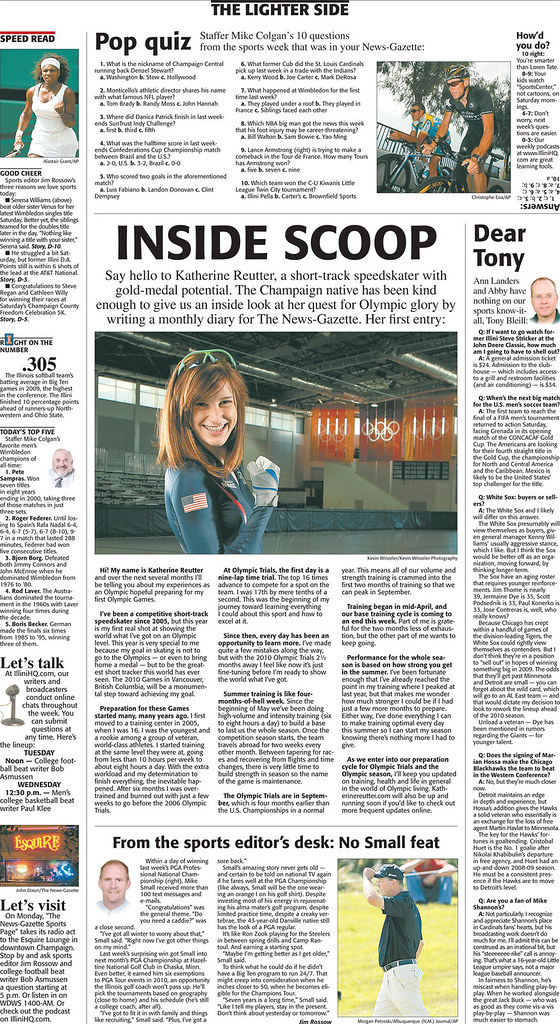
Behind the scenes Sports Photography Shoot | Olympic Speed Skater: Katherine Reutter


I'd highly recommend becoming familiar with one of the coolest and most underrated Olympic sports,
short track speed skating prior to the Olympics in just 7 months. While you're at it, check out
Katherine Reutter and her story during the upcoming 2010 Vancouver Olympic Games
(Winter). She is young, energetic, already a champion and super fun to work with.
Prior to our shoot she had put in a seriously long and painful workout and still came strong
with lot's of energy for the photos. Go Katherine!! We'll be pulling for you. Also a little shout out
to friends Jason and Ty Fredericks (w/ odd animation, Justin Thorstrom, Stephanie Winzeler and
Nate Biddle for producing, assisting and helping direct the shoot. And a special thanks to Jason
Thompson for filming and editing this short clip! (Check out J's grass routes food show for some
tasty eats here)

--

This article just popped up in the News-Gazette.com featuring a nice little Q&A about Katherine's
journey to the olympics along with one of the portraits from our shoot.


hi! my name is Katherine Reutter

and over the next several months I’ll

be telling you about my experiences as

an Olympic hopeful preparing for my

first Olympic Games.

i’ve been a competitive short-track

speedskater since 2005, but this year

is my first real shot at showing the

world what I’ve got on an Olympic

level. This year is very special to me

because my goal in skating is not to

go to the Olympics — or even to bring

home a medal — but to be the great-

est short tracker this world has ever

seen. The 2010 Games in Vancouver,

British Columbia, will be a monumen-

tal step toward achieving my goal.

preparation for these games

started many, many years ago. I first

moved to a training center in 2005,

when I was 16. I was the youngest and

a rookie among a group of veteran,

world-class athletes. I started training

at the same level they were at, going

from less than 10 hours per week to

about eight hours a day. With the extra

workload and my determination to

finish everything, the inevitable hap-

pened. After six months I was over-

trained and burned out with just a few

weeks to go before the 2006 Olympic

Trials.

at olympic Trials, the first day is a

nine-lap time trial. The top 16 times

advance to compete for a spot on the

team. I was 17th by mere tenths of a

second. This was the beginning of my

journey toward learning everything

I could about this sport and how to

excel at it.

since then, every day has been an

opportunity to learn more. I’ve made

quite a few mistakes along the way,

but with the 2010 Olympic Trials 21/2

months away I feel like now it’s just

fine-tuning before I’m ready to show

the world what I’ve got.

summer training is like four-

months-of-hell week. Since the

beginning of May we’ve been doing

high-volume and intensity training (six

to eight hours a day) to build a base

to last us the whole season. Once the

competition season starts, the team

travels abroad for two weeks every

other month. Between tapering for rac-

es and recovering from flights and time

changes, there is very little time to

build strength in season so the name

of the game is maintenance.

The olympic Trials are in septem-

ber, which is four months earlier than

the U.S. Championships in a normal

year. This means all of our volume and

strength training is crammed into the

first two months of training so that we

can peak in September.

Training began in mid-april, and

our base training cycle is coming to

an end this week. Part of me is grate-

ful for the two months less of exhaus-

tion, but the other part of me wants to

keep going.

performance for the whole sea-

son is based on how strong you get

in the summer. I’ve been fortunate

enough that I’ve already reached the

point in my training where I peaked at

last year, but that makes me wonder

how much stronger I could be if I had

just a few more months to prepare.

Either way, I’ve done everything I can

to make training optimal every day

this summer so I can start my season

knowing there’s nothing more I had to

give.

as we enter into our preparation

cycle for olympic Trials and the

olympic season, I’ll keep you updated

on training, health and life in general

in the world of Olympic living. Kath-

erinereutter.com will also be up and

running soon if you’d like to check out

more frequent updates online.